Showing posts with label Buildings. Show all posts

Sunday, February 1, 2009

Belgian Converts Getting Their Own Flemish Mosque

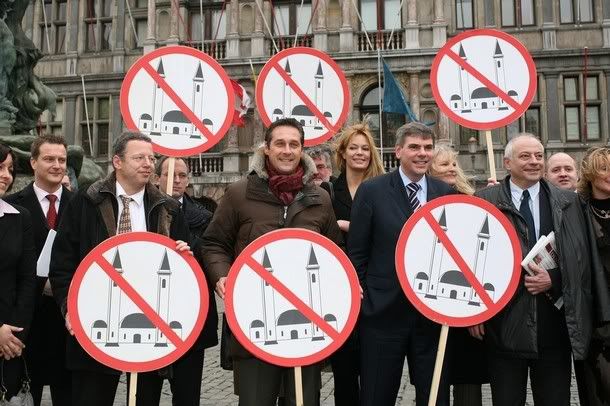
'Cities against Islamisation' in Antwerp,
17 January 2008.


I have recently added Islam in Europe as another link to my blog roll. A recent post from there caught my attention, in view of the convert stories I have written about here and here.

Belgian converts are having a hard time following the Arabic in the cities' mosques, and have decided to open their own mosque with Flemish as the principal language.

Rates of converts are pretty high, with the Antwerp Imam seeing to one to two converts every day. Now this could be an exaggeration by the Imam, but even one to two every week is pretty high.

According to Islam in Europe, there are 150 Muslim converts in Flanders (seems a little low). But numbers are growing, and these dedicated new Muslims want to get into the business of worshiping as fast as possible.

What is more interesting, though, is that more than half of the citizens of this Antwerp suburb, where the mosque is being established, are Muslim.

My argument all along has been that with more Muslims in a certain location, the more likely the non-Muslim population is going to get influenced by them. You cannot get a sufficient number of converts to build their own mosque without this influential presence in the first place.

Saturday, September 27, 2008

"Islamic centers" as fronts for mosques

Toronto has a nostalgic view of itself as the city with a church in every corner.

Well, "a mosque in every corner" doesn't sit so well, does it? And that is just what's happening. But, once again to avoid the shock and antagonism that could occur if this infiltration into our street corners were unveiled, these mosques are being called "Islamic centers." And, some are braving the unresponsive (for now) Canadian psyche by using masjid, the Islamic name for mosque.


The above photo shows the corner Masjid Toronto - which has been "loosely" translated as "Islamic Center of Downtown Toronto." The building was originally a bank


The time bomb that is Islam

photoq
Shot of screen with the CN Tower and Rogers Center
looming over Toronto, clearly looking like a mosque.
From the Arabic program Omniyat TV.

Photo1
CBC program Little Mosque on the Prairie
overshadowing the landscape

I recently reviewed a Canadian "sitcom" Little Mosque on the Prairie, and its incongruous setting. We'll be seeing a lot more of this kind of thing, since the Canadian public finds it amusing, quaint or not worth mentioning when Islamic imagery slowly start to seep into our landscape.

The latest casualties are the CN Tower and the Rogers Center. They are used as the final shot for one of Toronto's multicultural programs, the Arabic news show Omniyat TV. It is no coincidence that the CN Tower is made to look like a minaret, and the retractable roof of the sport center to look like the dome of a mosque.

The same subtle intrusions into our psyche (because that is the level of their intrusion) is happening on a more mundane level. For example, walking down Yonge street (not too far from the high-class Bloor and Yonge) one can hear Arabic music blurting from the storefronts, especially in the summer with doors and windows opened wide.

People better start paying attention to stories like this from Britain, where whole regions are becoming no-go areas for non-Muslims. Unlikely in Canada, you might say. But who would have thought that someone would transform Laura Ingalls' book (the title at least) of into a prairie full of Muslims? Out there in the middle of nowhere?

More mosque-like CN Tower and Rogers Centre


Here is another appropriation of the CN tower and the sport's dome conveniently photographed to make them look like a mosque and a minaret.

The whole idea of Muslims at this point is to furtively take over our visual vocabulary by putting their Islamic objects in familiar places.

The longer we see these places through Muslim lenses, then the less surprised and antagonistic we will be when bigger things start happening. As is happening with the London mega-mosque which still in the works.

But, the lesson to be learned from this London mega-mosque is that its opponents are not against other (smaller) mosques, but are against the size of the mosque, and some unconvincing worries about the "extremist" nature of the group that's building the mosque.

They don't realize that size doesn't really matter to get the Islamic messages across. That with enough smaller mosques, Muslims just keep getting the audacity to think of even bigger projects as a kind of triumphant arrogance that they are taking over.

Then they do something outrageous like the London mega-mosque to test the waters. And then, of course, they'll be back, more toned down, but progressively getting bolder.

Masjid Toronto's new engravings on its windows

Right: Masjid Toronto sign in downtown Toronto; Left: Arabic engraving on window

More engravings on entrance doorways, and on side windows

Older photograph from internet, showing doorways and windows
without decorative engravings

It is hard to keep up with the upgrades of the various Islamic buildings around Toronto.

Masjid Toronto, or as it is also euphemistically calls itself "Islamic Information Centre of Downtown Toronto", has embellished its windows with engravings of a mosque, some Islamic mosaic-style decoration, and script in Arabic. Although I don't know what this script means, I guessed it to be Allah. And sure enough a quick internet search produced these variations - scroll down to calligraphy #6 in the link.

This little corner mosque seems innocuous enough, except it is close to several very important landmarks, including:
- The Toronto General Hospital
- The University of Toronto
- City Hall
- The U.S. Consulate
- The Eaton Centre

Map of Masjid Toronto, with surrounding important Toronto landmarks

A: Masjid Toronto, B: The U.S. Consulate; C: City Hall; D: Toronto General Hospital
E: University of Toronto; F: Queen's Park; G: Eaton Centre; H: Ryerson University

Islamic style facade in a quiet residential area

Small, ominous signs of Muslim presence are cropping up in residential areas. This new building in the down town of a Canadian city, is a 21st century version of the Moorish Revival which occurred in cities in Canada around the 19th century. What is different about this new resurgence is that it is also accompanied by large Muslim groups, who are building their other institutions to continue their cultural and religious practices here. It is more of an insurgence.

But, the more we get used to these ogee arches in ordinary buildings, the more we will be accepting when more radical shapes likes mosque domes and minarets. It is after all, just “architecture.”

Friday, September 26, 2008

Moorish Revival, with a twist

On Church Street, the former Athenaeum Club has incorporated
its "Moorish Revival" style onto a condo's facade.

I've consistently said that Canadians are either very naive or deeply irresponsible. A recent article I came across from Spacing Toronto entitled "Toronto meets Marrakesh" leads me to think that the sin lies in irresponsibility.

The online blog, which is part of a print edition, describes itself thus:

Spacing Toronto is your hub for daily dispatches from the streets of Toronto to cities around the world, offering both analysis and a forum for discussion. Our contributors examine city hall, architecture, urban planning, public transit, transportation infrastructure and just about anything that involves the public realm of our cities.
Clearly a blog and magazine that tries to understand the urban landscape of cities across Canada.

But, the writer of "Toronto Meets Marrakesh", Thomas Wicks, is incapable of differentiating between a benign, and even flourishing, urban landscape, and that which is endangered.

European and American artists have always had a fascination for foreign cultures, from African masks, to Chinese ceramics to exotic "Moorish" styles. Often, they lived in these cultures for some time, or spent years traveling back and forth, while borrowing from, and being inspired by, their alien friends.

Still, the bottom line has always been that they never transformed their societies with these strange and foreign elements. Whatever they brought, somehow and not always tidily, fit into their European or American environments.

Wicks' great description of the Toronto landscape of the early 20th century, when there was a general Moorish Revival through architecture, art and design, shows that many of these elements (they were actually very few) somehow blended in, albeit a little incongruously, with the rest of the city, and Toronto went on being Toronto and nothing fundamental changed.

Yet, Wicks' attempt to favorably compare the latest "Moorish" incursion with the original one is completely erroneous and dangerous.

There is no Moorish Re-Revival. There are no artists and architects who, enchanted by these faraway lands, tried to bring a little of that exoticism back to their hometown.

What we have now is actual "Moors" right here, who are adamant about changing the landscape to fit their world view. They are not building mosques and minarets as quaint additions to a northern city, but as buildings which will transform this city. There will not be one or two buildings dispersed here and there, but whole regions which will be under the visual and aural spell of this new landscape.

Wicks appears to be a regular writer for Spacing Toronto. I hold him responsible for his myopia and wrong analogies, since he appears to be a professional. He will be directly responsible for the innocent bystander who will have to hear chants five times daily from the minaret that was built just across his home. And even if he moves to another place, a new one is sure to rise up again.

Canadians are certainly not naive. They have ample evidence, information and proof. They are ultimately profoundly irresponsible to their society, their environment and their landscape.