Sunday, May 31, 2009

Visible Minorities in the Greater Toronto Area

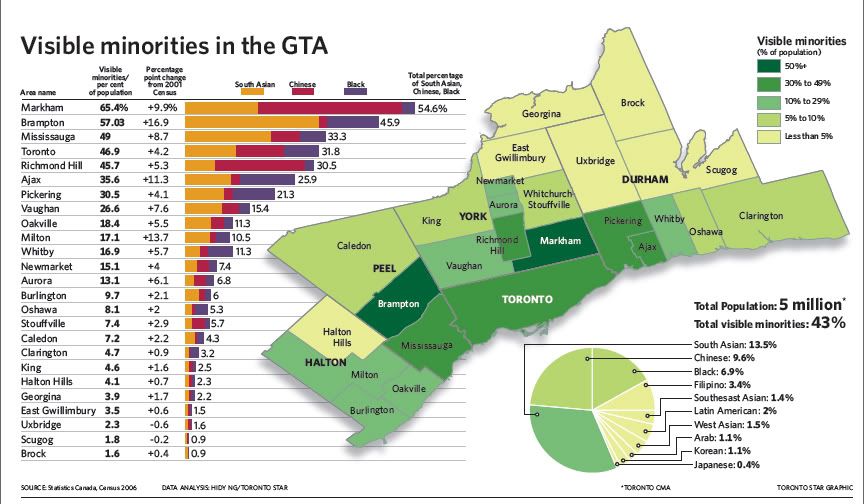
[Click on image to see larger version]

What's the Difference Between Levant and the HRCs?

I wonder if Ezra Levant reads this blog? Or if he's just too busy doing his book tours and op-eds for the Toronto Star - yes, the leftist newspaper of Toronto (and Canada, really).

I admire fighters; it takes energy and commitment to go after your enemies, and to correct the wrong being done.

But, at the same time, it is important to understand what you're fighting for, and why.

I've always held Levant's freedom of speech and freedom of the press stand for his fight against the HRCs to be inadequate. It is understandable where he is coming from since he was attacked as a journalist, and for what he chose to publish in his magazine. But he has admitted that he doesn't find the HRC principles fundamentally wrong, except that they went over-board with their current cases. 

Here is an excerpt from a piece Levant recently posted on his website titled, "Human rights activist speaks to multicultural forum on behalf of Metis host" which tells us more of his position:
I don't think about the ethnic or racial details of my friends -- unless it specifically comes up for some reason. And it generally doesn't come up -- unless some foolish political correctness demands that it come up, in the form of racial quotas or the like.

[H]uman rights commissions judge everyone based on those irrelevant criteria. They immediately assign you your political and legal status based on your race, sex, sexual orientation, etc. They ignore Martin Luther King's call to be judged by the "content of our character, not the colour of our skin".
The problem isn't that the HRCs are racist (they may well be, I don't know the inner workings of their staff and supporters). The problem is that the cases filed with the HRCs are categorized by groups deemed to be vulnerable to discrimination. The whole point of the HRCs is to protect such "minority" groups from majority group discrimination. They are set up to rule on differences, or at least complaints made by those "different" who want to be treated the same as everyone else.

So, what makes Levant any different from the HRCs? Both seem to believe in a neutral, equal society, where men and women, black and whites, Muslims and Christians, gays and straights, the old and the young, are all equal, and live in the multicultural harmony that Levant hopes is Canada.

As I pointed out in my previous post, about one half of those protected groups are visible minorities. They are protected against discrimination from equal access to employment, housing, services, and a host of other things.

Ontario's minorities filed about 1/3 more complaints to the HRC than did Alberta between 2007 and 2008.The highest number of complaints in Ontario came from visible minorities (39% vs. 18% for Alberta). Ontario has also almost twice the number of visible minorities as Alberta.

Immigrants contribute large numbers to the visible minorities' pool, as I showed in my previous posts [1, 2]. With the increasing acceptance of immigrants , there will be an increasing number of visible minorities, and an increasing number of HRC cases. 

Visible minorities, those people that he doesn’t want to put into "racial quotas", are changing Ezra Levant’s Canada. They are not beholden to the founders and creators of Canada, unlike Levant. The fair and just society that Levant makes speeches about is changing through the unfair and vindictive HRCs that he’s trying to reform.

Part of the fuel that keeps the HRCs burning are people whose entry into Canada Levant, and Jason Kenney, need to find ways to reduce to avoid the inevitable, negative changes to society and culture that Levant is already bemoaning. This includes his cherished freedom of speech, which allows him to still speak the way he does, but which could change for the worse.

-----------------

Here are some facts about the Ontario, Alberta and British Columbia HRC cases between 2007 and 2008:

Ontario New Complaints to the HRC:
3,491 (filed by 0.03% of the total population)
A 49% increase from previous year

% Breakdown of complaints
- Visible minority: (an amalgam of race, place of origin, ethnicity, ancestry and creed): 38.8%
Race being highest at 18.2%

- Disability: 27.6%

Ontario visible minorities: 22.8% of Ontario population
Toronto visible minorities: 46.9% of Toronto population

Source: Ontario Human Rights Commission 2007-2008 Annual Report
-----------------

Alberta New Complaints to the HRC:
680 (filed by 0.02% of the total population)
A 4% increase from previous year

% Breakdown of complaints
- Visible minority: (an amalgam of race, place of origin, ethnicity, ancestry and creed): 18%
Race & Ancestry highest at 8% each

- Disability: 38%

- Gender: 20%

Alberta visible minorities: 13.9%

Source: Alberta Human Rights Commission, Annual Review, April 1 2007 - March 31 2008 (pdf)
-----------------

British Columbia New Complaints to the HRC:
1,053 (filed by 0.02% of the total population)

% Breakdown of complaints
- Visible minority (an amalgam of race, place of origin, ethnicity, ancestry and creed): 41%
Race highest at 12%

- Disability - 20%

B.C. Visible Minorities: 24.8%

Source: B.C. Human Rights Tribunal Annual Report, 2007-2008 (pdf)
-----------------

Saturday, May 30, 2009

Update on Immigration and Visible Minorities

Here is a report by the Bellissimo Law group (immigration lawyers, so they should be happy) about the commitment to immigration by Jason Kenney, minister of citizenship, immigration and multiculturalism, for 2009:
Canadian minister of citizenship, immigration and multiculturalism, Jason Kenney, has great plans to welcome between 240,000 and 265,000 new permanent residents.

On November 28, 2008, Minister Kenney announced that he is committed to his immigration program to balance Canadian's [sic] economic, humanitarian and family reunification goals. Minister Kenney plans to include up to 156,600 immigrants in the economic category; 71,000 in the family category; and 37,400 in the humanitarian category.

In 2007, projecting for 2008, another law firm, the Campell Cohen law firm, announced that:
Citizenship and Immigration Canada announced...that the target for permanent residents will increase by 15000 in the upcoming year [of 2008]...

In 2007 Canada plans to admit between 240 000 to 265 000 permanent residents, up from a range of 225 000 to 250 000 this calendar year.

So, the projected acceptance went up for 2008, and remained high for 2009 (higher than for 2006), despite a more conservative government, and a minister of citizenship, immigration and multiculturalism who plans to rewrite the citizenship test because Canada "can't afford to be passive about the challenges of integration."

If Jason Kenney is still concerned about the integration of immigrants, after so many years of immigration, shouldn't he be questioning what it is about these newer immigrants that makes them less likely to integrate, rather than rewriting the citizenship test? 

I hope Ezral Levant is also able to help out Kenney with these questions.

My Question to Ezra Levant

I have high regard for Ezra Levant's battle against the overbearing Human Rights Commissions. I'm sure he has put his life on hold for the last few years to pursue this. But then, his life was put on hold with his three-year case and thousands of dollars spent fighting the Alberta Human Rights Commission.

My question to him is this:

In view of my short report below about visible minorities and the Human Rights codes which specifically attempt to defend their grievances, and the increasing number of visible minorities in Toronto mostly due to immigration, is it enough for Levant to ask for the removal of the HRCs without doing something about the group that is propping them up?

Increased immigration only adds more potential cases for the HRC, and as immigrants’ numbers increase, so does their power to influence HRC for their benefit.

Shouldn’t Levant be talking about reducing immigration and the dismantling of the HRCs at the same time?

Immigration and Visible Minorities

In my last post, I ruled that the HRCs are here to stay. My argument is that as long as there are high levels of immigration mostly from non-Western countries, of immigrants who are unaccustomed or unable to participate in the traditional Canadian culture and society, more and more strong-arm techniques will be used to enforce equality. 

One of the ways this is achieved is through the HRCs. According to The Agenda's most recent panel "Ontario's human rights tribunals: adjudicating injustice ... or hurt feelings?" (now available on video), the Ontario Human Rights code, which is enforced by the Ontario Human Rights Commission, protects individuals from discrimination against:   

- Race
- Ancestry
- Place of origin 
- Color
- Ethnic origin
- Citizenship
- Creed
- Sex
- Sexual orientation
- Age
- Record of offence
- Marital status
- Family status
- Disability

A full half of these potentially involves the kind of immigrants that are predominantly being accepted into Canada. Here are some statistics from the 2006 census:
 
Percent of visible minorities in Toronto[1]:
Total - 46.9%

Highlights:
Arab - 0.9%
Black - 8.4%
Chinese - 11.4 %
Filipino - 4.1 %
Korean - 1.4%
Latin American: 2.6%
South Asian - 12%
West Asian - 1.7%

Percent change in visible minorities in Toronto between 2001 and 2006 (mostly due to immigration)[1]:
Total: + 11%
Latin American: + 19%
Filipino: + 19%
South Asian: + 18%
Chinese: + 9%
Black: + 2%
 
My point, therefore was, as long as such large numbers of immigrants are entering the country and are allowed to live, work and eventually hold citizenship here, then the Human Rights code will invariably be abused (or over-used), and there will be a perennial stream of complaints  and cases, in increasing numbers, made to the HRCs. 

-----------------------------
1. Release of the 2006 Census on Ethnic Origin and Visible Minorities, City of Toronto (pdf)

Thursday, May 28, 2009

Now For a Bit of Humor


From the BBC website:
A Muslim chef who accused the Metropolitan Police [he worked in the police training college in Henden, North London as the catering manager] of religious discrimination when told he must handle pork has lost his tribunal case.

The Human Rights Commissions Are Here To Stay

There must be something going on in TVO these days, and especially with Steve Paiken's program The Agenda. He is consistently producing programs relating to Toronto's (and Canada's) multicultural and immigrant society.

This evening, he hosted a panel on the Human Rights Commission entitled: "Ontario's human rights tribunals: adjudicating injustice ... or hurt feelings?"

All his guests were lawyers, except for one who is a clinical psychologist. One, as well as being a lawyer was also chair of the Human Rights Legal Support Centre.

There will be a video or an audio coming out soon (usually a day after the program), but there was nothing new or insightful that this group brought to the picture. In fact, for bona fide lawyers, one would have thought that at least one of them would have talked about the pseudo-justice system that the HRCs have set up, as Ezra Levant has demonstrated.

The only thing that happened was that I had an epiphany.

The HRCs are not going anywhere. If anything, they will just be fine-tuned to avoid the wrath of ordinary folks who may have realized their fraudulent nature from Levant's and others' exposures .

I got this affirmation when an older black woman, in all sincerity, asked when Canada was going to change the underlying problems of inequality and barriers to minorities, since the HRCs are only there to report the problems that this unequal society produces.

Canada is a multicultural society. Not only that, it is an officially multicultural society, with a Multicultural Act introduced in 1988. It also is not letting up on immigration any time soon. And the majority of immigrants are still coming from non-Western countries.

This means that Canada's society has a built in unequal structure. This inequality, which manifests itself if allowed to run its own course, is forever being reined in by various forces, usually governmental, at times simply social and psychological. The HRCs are the forceful, governmental arm of squaring this circle, of making everyone equal, or at least appear equal. And these strong-arm procedures will continue as long as there is this multicultural society, and as long as 250,000 immigrants, the majority of which will feel part of the stigmatized groups, are let into the country annually.

The HRCs are here to stay.